
Wanna be a Creative Arts Therapist?
Once a month or so, I receive an inquiry from someone asking for advice on pathways to become a creative arts therapist in Australia. If you're reading this, I’m assuming you've discovered the transformative and experiential power of creative and expressive therapies and that your curiosity has evolved to wanting to embark on training.
Art therapists have many different backgrounds and journeys to how they found the field. Maybe you already have an arts background. Maybe you've been working in mental health or community services and want to bring something different to the table. Maybe you've experienced the power of art-making in your own life and want to understand how to hold that space for other people.
Whatever brought you here, the pathway to becoming a creative arts therapist in Australia is something that can feel quite broad when you start researching options. However, to secure roles in allied health, the pathway that you need to take is quite specific. And, if you are looking at training specifically to become an art therapist, the single most important thing I can tell you before you enrol in anything is this: check that your course will actually make you eligible for professional registration in Australia.
A quick note before you read on.
This information is correct to the best of my knowledge at the time of publishing in early 2026. However, things like professional registration requirements, NDIS provider eligibility and program lengths can change.
Embarking on study to become a therapist is an incredibly rewarding path - please just make sure you do your diligence before making any big decisions!

What is a creative arts therapist, exactly?
Creative arts therapists are mental health professionals who use creative and expressive modalities (drawing, writing, sculpting, drama, clay, sand, dance and movement) to facilitate the exploration of feelings, improve self-awareness and support mental health, wellbeing and personal development.
A creative arts therapy session is therefore quite different to an art class or lesson. It's not asking someone to draw their feelings and then telling them what it means. Creative arts therapy is a form of psychotherapy, grounded in theory and clinical training, where the art-making process itself becomes a way of exploring and making sense of lived experience. The focus is on the process of creating, the relationship between therapist and client, and what emerges through that, not on producing a nice-looking artwork.
In Australia, creative arts therapy is a self-regulated profession. That means it's not regulated by AHPRA (the Australian Health Practitioner Regulation Agency) like psychology or occupational therapy. Instead, the profession is overseen by peak professional bodies ANZACATA and PACFA.
The professional bodies: ANZACATA & PACFA
ANZACATA stands for the Australian, New Zealand and Asian Creative Arts Therapies Association. It is the peak professional body representing creative arts therapists across the Australia, New Zealand and Asia-Pacific region.
ANZACATA sets the training standards, maintains a code of ethics, provides professional indemnity insurance access, publishes a peer-reviewed journal (JoCAT), and maintains a public directory where people can find a registered creative arts therapist.
Professional members of ANZACATA can use the post-nominal AThR (registered Arts Therapist). This is the recognised professional title in Australia and it tells clients, employers and funding bodies that the therapist has met specific training and practice standards.
PACFA (the Psychotherapy and Counselling Federation of Australia), is a national peak body representing the self-regulating allied health professions of psychotherapy and counselling. PACFA has a dedicated division called the College of Creative and Experiential Therapies (C.CET) to provide a professional home for therapists who work using more than verbal methods including visual art, dance, drama and music. Both pathways represent a commitment to professional standards and ethical practice; they sit within different organisational structures and suit different practitioners depending on their training background and scope of practice.
Professional registration matters practically and financially, as it’s often an essential requirement to secure employment as a therapist within the industry. If you want to work within an allied health setting (such as a hospital) or you want to provide creative arts therapy through the NDIS, you need to be a professional member of ANZACATA or PACFA. Following the Duckett Review in 2025, the NDIA confirmed that art therapy will continue to be funded under the NDIS, but only when delivered by a qualified therapist who is registered with a recognised professional association. For art therapy, that means ANZACATA or PACFA.
The qualification you need
As noted on my website, I am registered with ANZACATA - so my understanding of qualification requirements is based on that professional body. To be eligible for ANZACATA professional membership (and to use the AThR title), you need to complete a Master's degree in art therapy or creative arts therapy that meets the following criteria:
It must be at AQF Level 9 (that's the Australian Qualifications Framework level for a Master's degree). It must include a minimum of 750 hours of supervised clinical placement. And it must be approved by ANZACATA.
There's an important change happening in July 2026 regarding Tiered membership. ANZACATA has previously offered a tiered membership structure that accepted graduates from courses at AQF levels 6 to 8 (Advanced Diplomas and Graduate Diplomas). From July 2026, ANZACATA will phase out the tier membership structure and will no longer accept qualifications below Master's level for new membership applications.
This makes the qualification requirements clear: a Master's degree is now the standard pathway into the profession to obtain professional registration.
Which courses are approved?
Both ANZACATA and PACFA maintain a list of approved Master's programs on their websites, and these are the lists you should check before you commit to anything. Even if the course’s training and marketing materials say that the course is approved, always check on the professional bodies website.
For ANZACATA, the approved Australian institutions for professional-level membership include universities in Melbourne, Sydney, Brisbane and Perth.
There are also approved programs in New Zealand, Singapore and Hong Kong for anyone considering studying outside Australia.
Each of these programs have their own theoretical orientation and structure. Some are more clinically oriented, some more research-focused, some more experiential and arts-based. The approach to therapy you learn during your training will shape your practice in significant ways. That said, I also want to note that the experiential and practice-based nature of therapy means that you will never stop learning - your approach as a practitioner will grow as you do. The course you study is the beginning of the journey, not the end!
A note on ‘non-approved’ courses
Here's where it gets tricky. There are many courses online that use words like ‘art therapy’ or ‘creative arts therapy’ in their name or marketing but are not approved by ANZACATA or PACFA. There are more non-approved than approved programs! Some of these are introductory courses that give you a taste of therapeutic arts, some are AI slop wrapped in ‘coaching progam’ bundles and some are incredible training opportunities that focus on specific styles or modalities of creative arts therapy. The key thing is, that unless they are listed as an approved course on ANZACATA or PACFA’s website they won't enable you to be eligible for professional membership.
Because creative arts therapy is a self-regulated profession in Australia, the title itself isn't legally protected in the way that ‘psychologist’ is. Technically, anyone can call themselves an art therapist. This is actually one of the reasons professional registration matters so much. It's the mechanism that gives the public (and employers, and funding bodies) a way to verify that someone has met a genuine standard of training and practice.
So before you enrol: go to the ANZACATA and PACFA website, check their approved courses list, and make sure the program you're considering is on it. If it's not, contact them directly and ask. This one step can save you years of study and thousands of dollars in a course that won't get you where you want to go. And, once you have graduated and are working as an art therapist, those incredible short courses that grow skills in specific modalities may be a great option for continuing professional development (CPD).
What does the training actually involve?
The specifics vary by program, but broadly, a Master's in creative arts therapy will cover psychological theory, therapeutic frameworks, ethics, research methods and critically, extensive supervised clinical practice.
Most if not all programs involve significant personal and experiential learning. There are theoretical components, but this isn’t something you can just read about, you need to do it! Creative arts therapy training tends to ask a lot of you as a person, not just as a student. You'll be making art, reflecting on your own processes, and developing your capacity to be present with other people's material. It can be confronting. It can also be profoundly meaningful.
Your training will likely involve at least one placement in a workplace, where you will work and learn as a therapist, supervised by the workplace and by your course provider. Placements require some flexibility and are often unfortunately unpaid. However, they are an integral and valuable component of supervised practice.
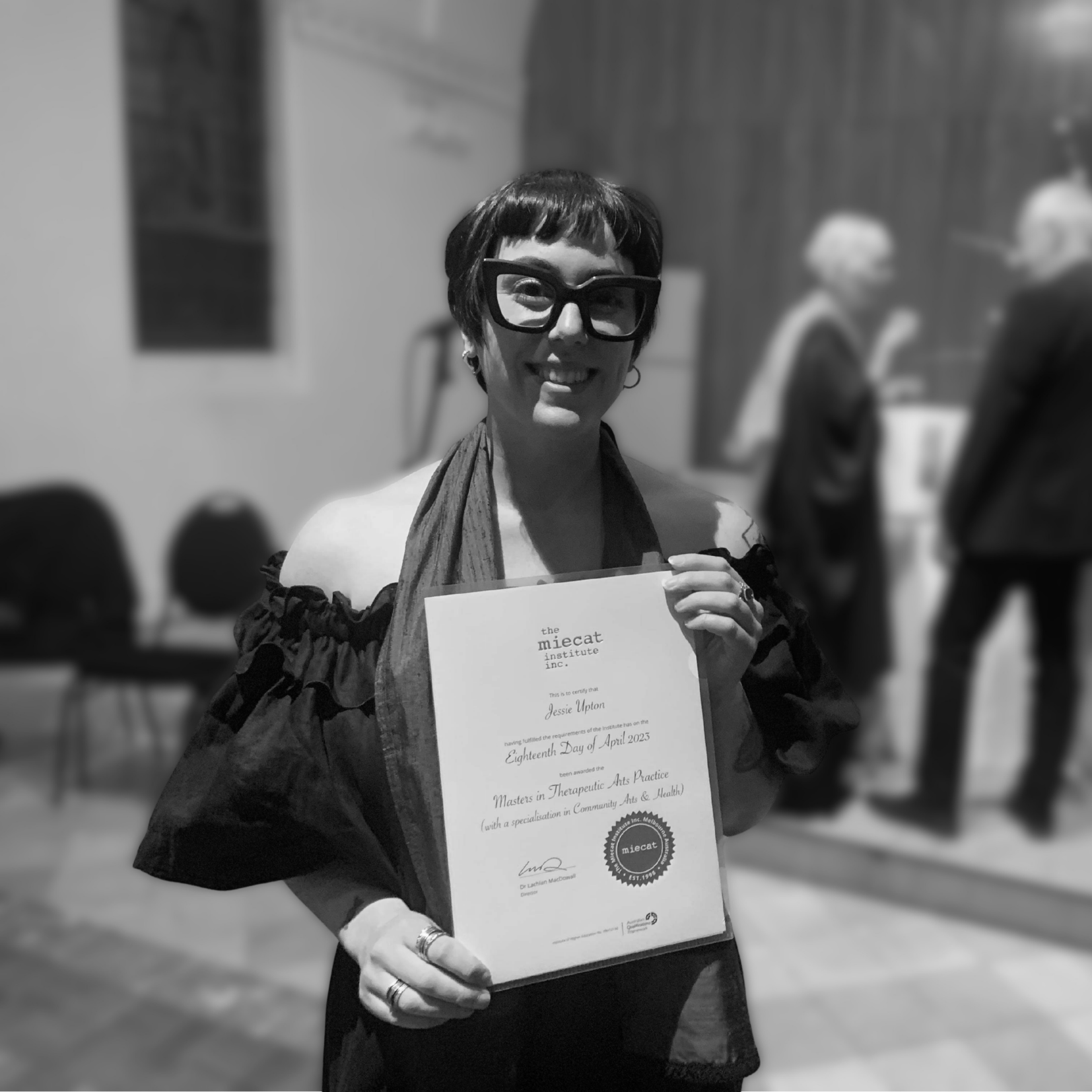
At my graduation, holding my Master’s certificate.
After you graduate
Once you've completed your Master's from an ANZACATA-approved program, you can apply for professional membership.
From there, maintaining your registration involves ongoing obligations. ANZACATA professional members are required to complete a minimum of 25 hours of continuing professional development (CPD) each year and maintain regular clinical supervision (the guideline is one hour of supervision for every 15 hours of client work).
You'll also need to comply with the ANZACATA code of ethics and be prepared for potential audits of your CPD and supervision logs. These requirements exist for a reason. Creative arts therapy is relational, often deeply personal work. Ongoing supervision and professional development aren't just boxes to tick. They're how you stay safe, ethical and effective as a practitioner.
A few other things worth knowing
Creative arts therapy in Australia is recognised as an allied health profession by Allied Health Professions Australia (AHPA), which adds a layer of professional credibility and advocacy. The profession is still relatively young in Australia compared to places like the UK, where art therapist is a protected title regulated by the Health and Care Professions Council. That means there's both a challenge and an opportunity: the field is growing, recognition is increasing, and there's room for practitioners who are willing to contribute to building the profession as it develops.
Career settings for creative arts therapists are broad: private practice, community health, hospitals, mental health services, schools, aged care, disability services, palliative care, corrections, organisational settings. Some therapists specialise in particular populations or approaches, and many combine clinical work with community projects, research or teaching.
In summary
If you want to become a creative arts therapist in Australia: I recommend that you study a Master's degree that is approved by ANZACATA or PACFA. To secure work in allied health or via the NDIS this is now non-negotiable.
Everything else, the modality you're drawn to, the population you want to work with, the theoretical orientation that resonates with you, can be figured out along the way as you learn, practice and grow your skills. But the qualification pathway is specific, and getting it right from the start will give you the best opportunity to secure and sustain work in the field. Both the study and work itself is rigorous and can be confronting at times. It can also be profoundly meaningful. Good luck!
Jessie Upton (AThR) is a Creative Arts Therapist and professional member of ANZACATA, based in Melbourne. They provide individual and group creative art therapy for adults, host a neurodivergent peer group for adults with ADHD & autism and offer creative capacity, organisational culture and reflective practice programs for organisations.